
Hip Resurfacing – what is it and who is a hip resurfacing candidate?
There are currently two basic surgery options available for hip replacement, a Hip Resurfacing or a Total Hip Replacement. A total hip replacement, THR, has been the gold standard for many years. THR is major surgery that can result in a long post-op recovery and often limits your activities depending on the type of hip device that has been used during surgery. Hip Resurfacing is bone conserving, not requiring the removal of
a large portion of the femur, and allows the patient to have an active life with no restrictions after surgery. Patients are able to return to sports, activities and pain free
lives.
Dr. Gross Discusses the Advantages of Hip Resurfacing vs THR
Dec. 3, 2012 in Columbia SC
Hip Resurfacing devices use a metal cap implanted
over the femoral head and a metal cup placed in the acetabulum to provide
a bearing surface. The use of this type of hip device results in a
metal on metal bearing arrangement and is an excellent
choice for hip replacement. The hip resurfacing procedure is bone sparing since it does not
require the femur to be cut off. In a hip resurfacing
operation, the surgeon removes only the diseased surface of
the head of the femur. A
spherical metal cap is fitted over the femoral head and the
stem of the cap is normally secured with bone cement.
The hip socket or acetabulum is lined with a thin spherical metal cup and
it is not normally cemented.
The Smith & Nephew Birmingham Hip Resurfacing
Device (BHR) was FDA approved in 2006, the Cormet Corin Hip
Resurfacing Device was FDA approved in 2007 and the Wright
Medical Conserve Plus Hip Resurfacing Device was FDA approved in
2009.
Hip Resurfacing offers the younger, active patient an
opportunity to return to a full active life without
restrictions and without pain. It is bone conserving
and has been the choice of surgeons for younger people in
the rest of the world since 1998
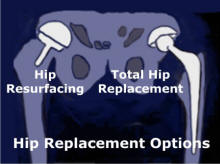
A total hip replacement means that the top portion of your femur bone
will be removed, the remaining bone will be drilled and a
device with a long stem will be placed into the bone. The
stem is secured with bone cement or secured with a press-fit
depending on the technique chosen by the surgeon. A
cup will be placed in the acetabulum of the hip to provide a
pivoting surface for the ball of the femur device. If you
ever need to have a revision, it is much more difficult to
removed the stem from the bone after it has been in place
for a number of years. The bone must be cut apart to removed
the old stem. Revision surgery of a THR is again major
surgery and often limits a person in their activities after
the revision. There are many types of hip devices and they
often dictate what activities are acceptable. The
newer, large head Metal on Metal hip devices offer a person
much more of a very active life style than the older, small
metal and plastic hip devices.
Hips for You
is a website all about total hip replacement.
There are two types of Hip Resurfacing:
a partial (hemi) hip resurfacing or a complete hip
resurfacing. The partial hip resurfacing results in a cap
being implanted over the femoral head. No cup is placed in
the acetabulum to provide a mating pivoting surface. The
partial hip resurfacing results in a bone on metal
situation. Partial hip resurfacing was the early accepted
form of hip resurfacing in the US and was not always
successful long term. The metal rubbing on the bone
often failed over time. A partial hip resurfacing was used
with patients who had osteonecrosis or AVN of the femoral
head. Partial hip resurfacing is not the best solution for
hip replacement today.
The Birmingham Hip Resurfacing Device by
Smith & Nephew was
approved by the FDA on May 9, 2006 and uses both a metal cap being implanted
over the femoral head and a metal cup placed in the acetabulum to provide
a bearing surface. The use of this type of hip device results in a
metal on metal bearing arrangement and is an excellent
choice for hip replacement. The new hip
resurfacing procedure is bone sparing since it does not
require the femur to be cut off. In a hip resurfacing
operation, the surgeon removes only the diseased surface of
the head of the femur. A
spherical metal cap is fitted over the femoral head and the
stem of the cap is normally secured with bone cement. The hip socket or acetabulum is lined with a thin spherical metal cup and
it is not normally cemented.
The Smith & Nephew Birmingham Hip Resurfacing
Device (BHR) was FDA approved in 2006, the Cormet Corin Hip
Resurfacing Device was FDA approved in 2007 and the Wright
Medical Conserve Plus Hip Resurfacing Device was FDA approved in 2009.
Hip Resurfacing offers the younger, active patient an
opportunity to return to a full active life without
restrictions and without pain. It is bone conserving
and has been the choice of surgeons for younger people in
the rest of the world since 1998.