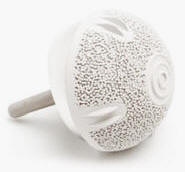
The BHR, Birmingham Hip Resurfacing, offers
younger, active patients more ROM, no restrictions of activities and
almost no possiblity of dislocations as many of the older THR hip
devices.
Derek McMinn and Ronan Treacy at the Royal
Orthopaedic & Nuffield Hospitals, Birmingham, UK, have more than 9
years experience with metal on metal hip resurfacing devices. Hip
Resurfacing offers a patient a bone conserving operation since the
femur head does not have to be removed, just reshaped to accept the
cap of the BHR. Should a revision
be required at some time in the future, there is still an intact
healthy femur allowing for a ‘primary’ hip without the normal
complications associated with revision.
Hip resurfacing has been shown to eliminate the
problems of proximal femoral stress shielding and osteolysis caused
by plastic wear debris associated with traditional plastic/metal THR
hips. Hip resurfacing eliminates the problems of hip dislocation and
significantly reduces the problem of leg lengthening.
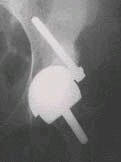
For patients with defects of
the acetabulum, the BHR offers the Dysplasia Cup. These are
available in 6 sizes from 46mm to 66mm in 4mm increments. The
Dysplasia Cups are available in 6 sizes from 46mm to 66mm in 4mm
increments. The cup has 2 superolateral threaded lugs which allow
for a unique screw fixation to ensure solid cup fixation in the
deficient acetabulum. Structural bone grafting is not required.
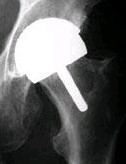
BHR
BHR with Dysplasia Cup
Metallurgy
The BHR* is produced using the investment casting
process from high carbon cobalt chrome in the As Cast micro-structural
condition.
Wear studies have shown that Cobalt Chrome in its As Cast form has superior
wear resistance to other forms of the alloy. 10, 11, 12
Heat treating, which includes hot isostatic pressing (HIP), solution heat
treatment (HT), wrought forging or sintering modifies the microstructure,
reducing the block carbides in both quantity and quality. This directly
affects the wear resistance of the metal, as shown in diagram A. 13, 14, 15
The importance of carbide structure has been demonstrated in independent
testing with other devices. A recent publication highlighted the difference
in the wear rates of heat treated and As Cast products. The cumulative
linear wear rate data showed substantially more wear with the heat treated
metallurgy when compared to the As Cast devices. 16
Clinical Evidence
The BIRMINGHAM HIP*
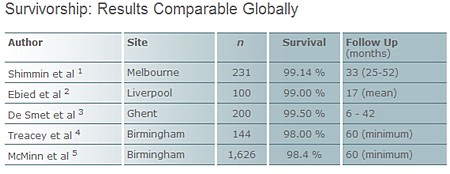
Resurfacing (BHR*) has demonstrated exceptional clinical results
worldwide. High survival rates of 98% or better were achieved in clinical
centres around the world. 1,2,3,4,5
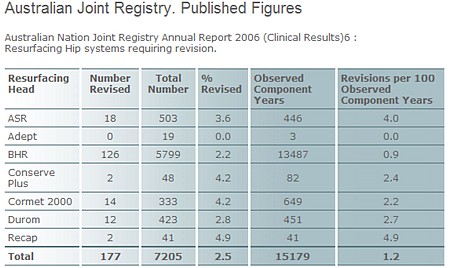
In addition, the recently published Australian
Orthopaedic Association National Joint Replacement Registry reports BHR as
having the lowest revisions per 100 observed ‘component’ years when
comparing all resurfacing implants used in the country. 6
Other clinical studies have focused on predictive
measurements to project long-term survivorship of the resurfaced femoral
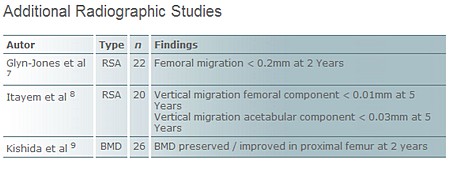
head. Researchers at the University of Oxford, England used roentgen
stereophotogrammetric analysis (RSA) to measure the stability of the femoral
head. At 24 months, the total three-dimensional migration of the head was
not statistically significant at 0.2mm.
Previous studies have shown that implants that loosen
quickly have rapid early migration. According to the authors, these results
suggest the BHR femoral component is an inherently stable device predicting
a good long-term performance. 7,8
It is widely accepted that the Bone Mineral Density (BMD)
of the proximal femur generally decreases after cementless THA using
standard designs of femoral components. However, BMD studies conducted at
Osaka University, Japan reported the post-operative BMD in the proximal
femur was significantly greater in patients treated with the BHR system
compared to the conventional system. The patients treated with the BHR
system demonstrated preservation of the BMD in Gruen zone 1 and an increase
in zone 7.
These results suggest that transfer of load to the
proximal femur was more normal after surface replacement with the BHR
system. These findings also show the BHR system preserves the bone stock of
the proximal femur after surgery. 9
Information from Smith & Nephew Website
Link
