
Femoro-acetabular Impingement- What it is
Femoro-acetabular impingement or FAI occurs when the ball
of the head of the femur does not have its full range of motion
within the socket of the acetabulum of the pelvis.
Impingement itself is the premature and improper collision or
impact between the head and/or neck of the femur and the
acetabulum. This causes a decreased range of hip joint motion,
in addition to pain. Most commonly, FAI is a result of excess
bone that has formed around the head and/or neck of the femur,
otherwise known as “cam”-type impingement. FAI also commonly
occurs due to overgrowth of the acetabular (socket) rim,
otherwise known as “pincer”-type impingement, or when the socket
is angled in such a way that abnormal impact occurs between the
femur and the rim of the acetabulum.
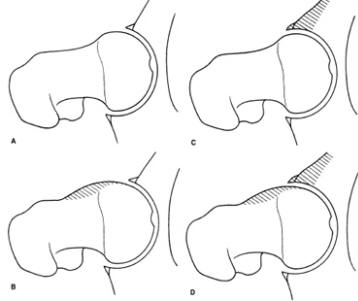
| A) | Normal Hip |
| B) | Cam impingement |
| C) | Pincer impingement |
| D) | Combination of cam and pincer impingement |
When the extra bone on the femoral head and/or neck hits the
rim of the acetabulum, the cartilage and labrum that line the
acetabulum can be damaged.
The extra bone can appear on
x-rays as a seemingly very small “bump.” However, when the
bump repeatedly rubs against the cartilage and labrum (which
serve to cushion the impact between the ball and socket), the
cartilage and labrum can fray or tear, resulting in pain. As
more cartilage and labrum is lost, the bone of the femur will
impact with the bone of the pelvis. This “bone on bone” notion
is most commonly known as
arthritis.