Refined Intraoperative X-ray Technique to Routinely Achieve
an Acetabular Inclination Angle < 50ºThomas P. Gross, MD
(d), Fei Liu, PhD (d)
Midlands Orthopaedics, P.A. Columbia, SC.6/5/2012INTRODUCTION
A steep acetabular inclination angle is the primary cause
of adverse wear related failure with well-designed
metal-on-metal bearing hip resurfacing arthroplasties (HRA).
One recent study demonstrated that positioning acetabular
components of stemmed total hip arthroplasties (THA) within
the “Lewinnek safe zone” is difficult; only 62% had AIA
within the safe zone. However, we have previously
demonstrated that acetabular components for HRA can be
placed with an AIA<55° in 96% of cases using intraoperative
X-ray. We now report our results using a refined technique,
suggested by our previous study, as well as a lower
acceptable limit for inclination angle (AIA<50°). We wanted
to determine how often the method allowed us to achieve an
AIA in the “safe zone for HRA”. We also wanted to know if
repositioning an acetabular component intraoperatively to
achieve an ideal position made it more likely to shift
postoperatively.
METHODS
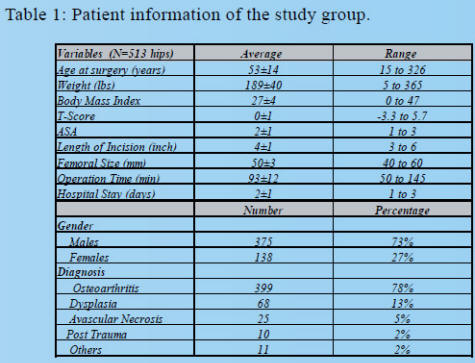
We evaluated radiographs of 513 consecutive
metal-on-metal HRAs performed by a single surgeon between Oct 2010 and Mar 2012.
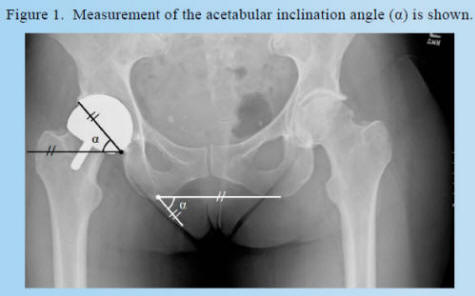
Intra-operative, recovery room supine pelvis, first postoperative day standing pelvis,
and 6-week standing pelvis X-rays were used to determine AIAs on all patients.
Our previous study indicated that an intraoperative target inclination limit of
45° was required in order to have a final AIA<50° on postoperative supine pelvis
XR 95% of the time. Therefore, in this series, if the intraoperative AIA
was greater than 45°, the acetabular component was repositioned and another X-ray was
taken to make sure it was within the target range. We prospectively
recorded all cases in which a component was repositioned. The difference between the
intra-operative AIA and the AIA on the standing postoperative day one X-ray were
compared to evaluate the effectiveness of the intraoperative X-ray
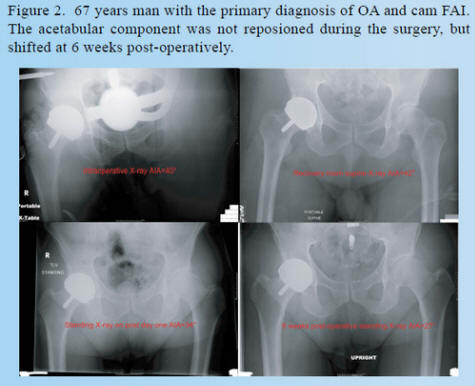
technique. In 144 of 513 HRA cases (28%) the acetabular component was repositioned
during surgery. X-rays taken at 6 weeks were compared to the recovery room
and postoperative day one X-rays to determine if any acetabular components
shifted postoperatively
RESULTS
Only one of 513 cases had an AIA outside our “safe range
for HRA” on the standing X-ray taken on the first postoperative day. In this
case, the intraoperative radiograph showed an AIA of 40°, while it was 50° on the
standing postoperative radiograph. The acetabular component was judged not to have
shifted. In all of the remaining 512 (99.8%) cases the AIA was within the
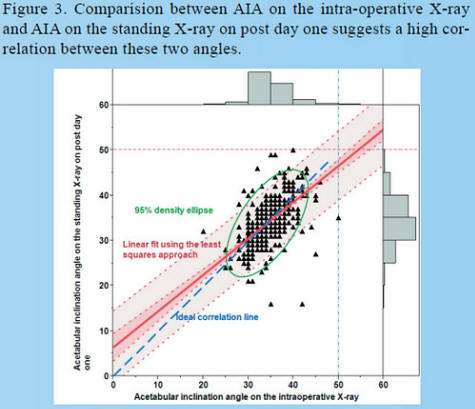
safe range of AIA< 50°. The average absolute difference between the AIA on
the portable intra-operative X-rays and the AIA on the standing X-ray on
post day one was 2.6°±2.9° (range: 0° to 26°). The variance was ≥ 5° in 83
(16.2%) cases and was ≥ 10° in 20 (3.9%) cases. One (0.7%) component in the
group in which the acetabular component was repositioned during surgery was
found to have shifted by the 6 week visit, while five (1.4%) components in
the remaining 369 cases (without intraoperative repositioning) were found
to have shifted (P=0.5).
CONCLUSIONS
In summary: 1. In 99.8% (512/513) cases, an AIA<50° was achieved on post
day one standing X-ray using an intraoperative target of AIA<45°. 2. The difference of the measured AIA between the
intraoperative and the postoperative standing pelvis XR was 2.6°±2.9°. 3. 28% cups required intraoperative repositioning to achieve
the intraoperative target. 4. 1 % (6/513) acetabular components shifted postoperatively
without adverse consequences. 5. Repositioning acetabular components did not increase the
chance of a postoperative cup shift. Message: We suggest measuring an intraoperative AIA and
repositioning the acetabular component until the AIA< 45°.
|
